


Episode Summary
Your company invested in a modern data platform. But your plant managers with 20+ years of operational expertise are refusing to use it. This is the classic data transformation paradox: you can build the best system in the world, but if experienced practitioners don’t believe in it, adoption fails. In this episode, Tiankai Feng (Director of Data & AI Strategy at ThoughtWorks) and host Lior Barak encounter this challenge head-on, discovering how to bridge the gap between data thinking and operational experience, and building the change management strategies that actually drive adoption in legacy organizations.Problem Category: Organizational Data Strategy / Change Management
Runtime: 32 minutes
Recording Date: 2024
The Problem
Submitted by: Anonymous
Industry Context: Family-owned manufacturer of watering systems, grown from 50 to 340 employees over 8 years
Problem Framework
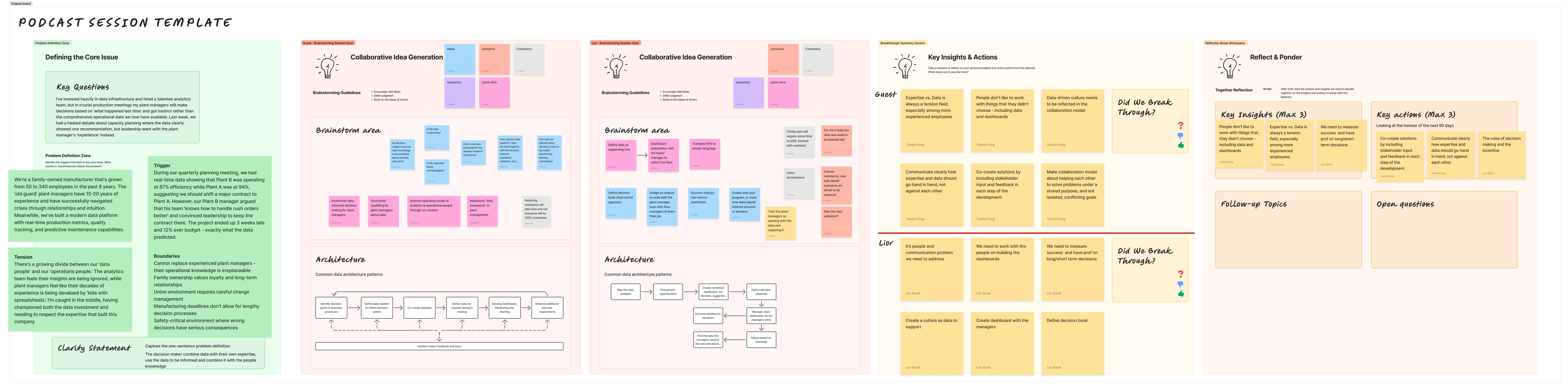
Issue: The company invested heavily in data infrastructure and hired a talented analytics team, but in crucial production meetings, plant managers still make decisions based on “what happened last time” and gut instincts rather than the comprehensive operational data now available. Last week, there was a heated debate about capacity planning where the data clearly showed one recommendation, but leadership went with the plant manager’s experience instead.
Situation: A family-owned manufacturer has built a modern data platform with real-time production metrics, quality tracking, and predictive maintenance capabilities. The “old guard” plant managers have 15-20 years of experience and have successfully navigated crises through relationships and intuition.
Trigger: During a quarterly planning meeting, real-time data showed that Plant B was operating at 87% efficiency while Plant A was at 94%, suggesting they should shift a major contract to Plant A. However, the Plant B manager argued that his team “knows how to handle rush orders better” and convinced leadership to keep the contract there. The project ended up three weeks late and 12% over budget - exactly what the data predicted.
Tension: There’s a growing divide between data people and operations people. The analytics team feels their insights are being ignored, while plant managers feel like their decades of experience are being devalued by “kids with spreadsheets.” The company is caught in the middle, having championed both the data investment and needing to respect the expertise that built the company.
Boundaries: Cannot replace experienced plant managers - their operational knowledge is irreplaceable. Family ownership values loyalty and long-term relationships. Union environment requires careful change management. Manufacturing deadlines don’t allow for lengthy decision processes. Safety-critical environment where wrong decisions have serious consequences.
Tech Stack: Modern data platform with real-time production metrics, quality tracking, and predictive maintenance capabilities (specific tools not disclosed)
Clarity Statement: Enable decision makers to combine data insights with their operational expertise to make the best decisions possible, while acknowledging both the value of experience and the value of evidence.
Our Guest
Tiankai Feng
Director of Data & AI Strategy at ThoughtWorks
Tiankai is passionate about the human side of data and AI, which is why he’s written two books: “Humanizing Data Strategy” (2023) and “Humanizing AI Strategy” (2024). At ThoughtWorks, a consultancy focusing on data and tech solutions, he helps organizations navigate the complex intersection of technology and people. He also uses his musical talents to make data and AI more approachable through songs like “Governors of Data” (about data governance) and “U&I and AI” (about the future of dating if AI is involved too much). His work emphasizes that successful data and AI strategies require understanding culture, communication, and change management - not just technology.
Connect with Tiankai:
LinkedIn: https://www.linkedin.com/in/tiankaifeng/
Books:
Humanizing Data Strategy: https://amzn.eu/d/hG8CSPt
Humanizing AI Strategy: https://amzn.eu/d/bZtMMI1
The Solution
Strategic Approach Overview
Rather than forcing adoption of the data platform or dismissing decades of operational expertise, the solution focuses on repositioning data as a support tool that enhances - rather than replaces - human judgment. The key is co-creation: involving plant managers in building the dashboards and decision frameworks they’ll actually use, while clearly communicating that expertise and data work hand-in-hand, not against each other.
Core Solution Components
1. Reframe Data as Support, Not Replacement (Foundation) The first critical shift is messaging: data is not here to replace the plant managers’ expertise or prove them wrong. It’s a support tool to help them make even better decisions. This addresses the fundamental fear driving resistance - that experienced managers will be devalued or replaced by technology. Lior shared the story of a friend whose family owned a coffee roasting business: when they introduced data-driven processes, one employee said, “Finally, I have time to smoke cigarettes” (don’t smoke!). The point: data created space for people to do other valuable work, not to eliminate their jobs.
2. Co-Create Dashboards and Data Sets (Quick Win - 30 Days) Never build dashboards in isolation and throw them over the fence. Bring plant managers into the design process from day one:
Identify decision points in business processes together
Define what data is needed for those decisions - with their input
Build dashboards that reflect their language and priorities
Translate technical KPIs into operational language they understand. This isn’t just good practice - people simply don’t use things they didn’t choose or help create. When stakeholders are part of the solution, they’re invested in its success.
3. Define Decision-Making Rules and Incentives (Long-Term - 60-90 Days). Create clear frameworks for when and how data should inform decisions:
Establish business rules (e.g., “if plant capacity drops below 50%, a data-driven decision is required”)
Define thresholds and triggers for different types of decisions
Clarify what decisions are data-driven vs. expertise-driven, vs. hybrid
Align incentive structures: if managers are only rewarded for short-term results, they’ll choose gut-feel solutions that work immediately rather than data-informed approaches that optimize long-term performance
4. Improve the Operating Model Between Teams (Cultural Shift) Address the “kids with spreadsheets” vs. “old guard” dynamic:
Create shared goals between analytics and operations teams (not competing objectives)
Assign analysts to work directly with plant managers (embedded collaboration, not remote reporting)
Establish data champions within plant management - find early adopters who can authentically advocate to their peers
Develop structured upskilling programs that respect existing expertise while building data literacy
5. Measure and Prove Value (Evidence Building) Build proof of data’s impact on both short-term and long-term decisions:
Track success metrics that matter to plant managers (on-time delivery, quality, safety)
Create “data success stories” showing how data + expertise led to better outcomes
Document cases where data prevented costly mistakes (like the Plant B example)
Use dashboards with monitoring and alerting to make data insights actionable, not just informative
Implementation Roadmap
30 Days (Quick Wins):
Reframe all communication: data as a support tool, not a replacement
Launch co-creation sessions with 2-3 plant managers to build the first dashboard together
Translate existing KPIs into operational language with manager input
Identify data champions among plant managers
60 Days (Structural Changes):
Complete first co-created dashboards with clear action triggers
Define decision-making framework: when to use data vs. expertise vs. both
Review incentive structures - do they reward short-term gut-feel or long-term optimization?
Establish regular collaboration sessions between analytics and operations
90 Days (Cultural Integration):
Implement the data champion program across all plants
Document first “success stories” of data + expertise wins
Roll out an upskilling program that honors experience while building literacy
Engage the union/works council proactively about the data’s supportive (not replacement) role
Key Takeaways
3 Critical Insights
Expertise vs. Data Is Always a Tension Field: Especially among experienced professionals who’ve succeeded without comprehensive data for decades. They’ve navigated crises through intuition, relationships, and pattern recognition - and it worked. Now they’re being told to trust numbers on a screen over their hard-won knowledge. The solution isn’t to declare one side “right” - it’s to communicate clearly that expertise and data should work hand-in-hand, not against each other. Value both sides. Make it about doing things better together, not devaluing someone’s unique experience.
People Don’t Use Things They Didn’t Choose: This is the fundamental flaw in most data platform implementations. The analytics team builds something in isolation, optimizes it for what they think matters, then presents it to stakeholders who had no input. Of course, they resist. Co-creation isn’t a nice-to-have - it’s essential for adoption. When you build dashboards, define metrics, and establish processes with the people who’ll actually use them, they become invested in the solution. They were part of the journey, not just handed a destination.
Success Metrics Must Reflect True Value: If plant managers are incentivized purely on short-term results, they’ll choose gut-feel solutions that show immediate wins - even if data suggests a different long-term approach. The question “how is success measured?” determines whether data gets used. When bonuses, promotions, and recognition are tied to quarterly performance, managers will optimize for that timeframe. For data to matter, incentive structures must reward both immediate operational excellence and strategic, data-informed optimization that pays off over time.
5 Action Items
For the Problem Submitter (and others facing similar challenges):
Reframe Communication Immediately (Week 1) - Stop positioning data as the “right” way to make decisions versus the “wrong” way of gut instinct. Start messaging: “Data is here to support your expertise, not replace it.” Have leadership explicitly communicate that plant managers’ operational knowledge is irreplaceable and that the goal is augmentation, not replacement. Address fears head-on, especially in union environments where job security concerns are legitimate.
Launch Co-Creation Sessions (Week 1-4) - Identify 2-3 plant managers who are at least neutral (if not enthusiastic) about data. Bring them into dashboard design sessions: “We want to build something that actually helps you. What decisions keep you up at night? What information would make those easier?” Build the first dashboard together, in their language, with their priorities. Use this as a proof-of-concept that others can see working.
Define Decision Framework and Rules (Week 4-8) - Work with plant managers to map decision points: Which decisions require immediate action based on floor expertise? Which benefits from data analysis? Which needs both? Create clear business rules and thresholds (e.g., “capacity below X requires data review before proceeding”). This removes ambiguity about when data should be consulted and prevents it from feeling like constant second-guessing.
Assign Embedded Analysts (Week 8-12) - Don’t have analytics teams work remotely and deliver reports. Embed analysts directly with plant managers - someone who sits with them, understands their daily challenges, and can translate between data insights and operational reality. This builds trust and ensures data solutions are grounded in real-world constraints (manufacturing deadlines, safety protocols, union requirements).
Review Incentive Structures (Ongoing) - Examine how plant managers are measured, rewarded, and promoted. If the system only values short-term performance, no amount of data evangelism will change behavior. Work with leadership to ensure success metrics acknowledge both immediate operational excellence and strategic, data-informed optimization. Create “data success stories” that leadership recognizes and celebrates - make data adoption visible and valued.
Episode Highlights
02:34 - Tiankai introduces himself and his musical approach to making data governance fun
04:46 - Problem reveal: “kids with spreadsheets” vs. decades of plant floor experience
08:07 - Tiankai’s critical question: “Why even build a modern data platform if no one is using it?”
09:15 - The clarity statement: enabling decision makers to combine data with expertise
11:49 - Tiankai’s brainstorming: “Have decision makers given feedback before, or was it built in isolation?”
13:40 - The incentive question: how are plant managers measured - short-term or long-term?
16:23 - Tiankai’s process architecture: identifying decision points and co-creating data sets
17:07 - Lior’s coffee roasting story: when data creates space instead of replacing people
19:42 - The translation challenge: making KPIs speak “people language”
24:35 - Refinement discussion: expertise and data must go hand-in-hand
30:50 - Tiankai’s follow-up point: change management is always the underestimated problem
Resources Mentioned
Humanizing Data Strategy by Tiankai Feng: Leading Data with the Head and the Heart - https://amzn.eu/d/hG8CSPt
Humanizing AI Strategy by Tiankai Feng: Leading AI with Sense and Soul - https://amzn.eu/d/bZtMMI1
ThoughtWorks: Consultancy focusing on data and tech solutions
Tiankai’s YouTube Channel: Songs about data governance (”Governors of Data”) and AI
Change Management frameworks: Referenced as critical for data platform adoption
Continue the Conversation
Submit Your Data Problem
Have a challenge you’d like us to tackle? Use our structured framework:
https://data-breakthroughs-podcast.cookingdata.blog/
Become a Guest
Data practitioner interested in collaborative problem-solving? Apply here:
https://data-breakthroughs-podcast.cookingdata.blog/
Share Your Alternative Solution
Did this episode spark a different approach? Share it with the community:
Use #DataBreakthrough on social media
Reply to the Wabi-Sabi Data newsletter
Implementation Follow-up
If you implement this solution, we’d love to hear about your results! Reach out for a potential follow-up mini-episode.
About Data Breakthroughs
Data Breakthroughs brings together data practitioners to solve real operational challenges through collaborative problem-solving. Each episode features authentic, unscripted brainstorming sessions focused on creating practical, implementable solutions.
Host: Lior Barak
Podcast Website:
https://data-breakthroughs-podcast.cookingdata.blog/
Credits
Host & Producer: Lior Barak
Guest: Tiankai Feng, Director of Data & AI Strategy at ThoughtWorks
Music: “Calisson” courtesy of Riverside
Accessibility
Episode Transcript: Auto-generated transcript available on all podcast platforms
Disclaimer
This podcast is for inspiration and educational purposes. The solutions and approaches discussed are general frameworks meant to spark ideas and collaboration. Always adapt recommendations to your specific organizational context, constraints, and requirements. The goal is to have fun while exploring data challenges together!


