


Episode Summary
Your analytics team has built comprehensive dashboards with 40+ charts per report. You have all the data anyone could want. But executives are paralyzed by choice—too much information, no clarity on what matters. The dashboard factory is destroying decision-making instead of enabling it. In this episode, Eva Schreyer (Head of Data & Analytics at Neugelb) and host Lior Barak tackle the analytics paradox: why more data and dashboards can actually cripple organizations. They explore how to escape dashboard chaos by focusing on strategic clarity and building analytics systems that matter.Problem Category: Business Intelligence & Dashboarding / Organizational Data Strategy
Runtime: 37 minutes
Recording Date: 2024
The Problem
Submitted by: Anonymous
Industry Context: Mobile application (B2C), subscription + ad-supported model, growth stage company with 200+ employees and 2-5 million active app users
Problem Framework
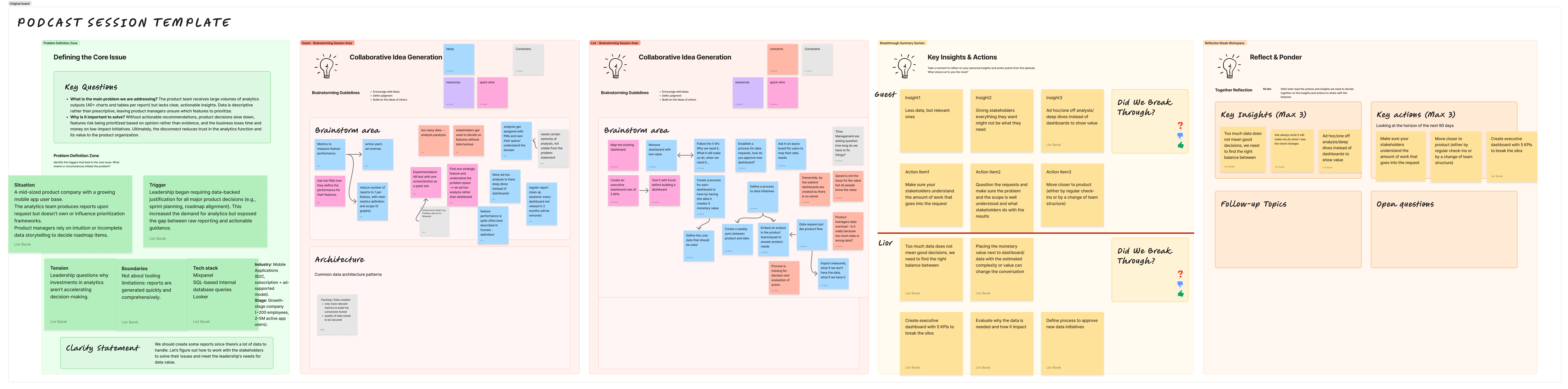
Issue: The product team receives large volumes of analytics output (40+ charts and tables per report) but lacks clarity on actionable insights. Data is descriptive rather than prescriptive, leaving product managers unsure which features to prioritize.
Trigger: Leadership began requiring data-backed justification for all major product decisions (sprint planning, roadmaps, alignment). This increased demand for analytics exposed the gap between raw reporting and actionable guidance.
Tension: Leadership questions why investment in analytics isn’t accelerating decision-making. Without actionable recommendations, product decisions slow down, features risk being prioritized based on opinion rather than evidence, and the business loses time and money on low-impact initiatives. Ultimately, the disconnect reduces trust in the analytics function and its value to the product organization.
Boundaries: Not about tooling limitations-reports are generated quickly and comprehensively. The analytics team produces reports upon request, but doesn’t own or influence prioritization frameworks. Product managers rely on intuition or incomplete data storytelling to decide roadmap items.
Tech Stack: Mixpanel, SQL-based internal database queries, Looker for visualization
Clarity Statement: Transform the analytics function from a reactive dashboard factory into a strategic partner that helps product managers make confident, data-driven prioritization decisions while demonstrating clear value to leadership.
Our Guest
Eva Schreyer
Head of Data & Analytics at Neugelb (Commerzbank)
Eva leads data and analytics for Neugelb, the tech hub of Commerzbank that builds mobile banking apps. Her team handles everything from data ingestion and infrastructure to analytics and insights, with the ultimate goal of influencing stakeholders to take action based on data. With experience navigating both startup-like environments and corporate structures, Eva brings a valuable perspective on balancing analytics depth with stakeholder engagement. She is also a co-organiser of dbt Berlin meetup and TLE - Tech Leadership Exchange.
Connect with Eva:
The Solution
Strategic Approach Overview
Rather than building more dashboards or improving existing reports, the solution focuses on fundamentally changing how the analytics team operates-from order-takers to strategic partners. The approach combines quick wins (executive alignment on core metrics) with structural changes (establishing request evaluation processes and embedded collaboration models).
Core Solution Components
1. Create Executive Alignment First (Quick Win) Start by creating a single executive dashboard with a maximum of 5 KPIs that everyone agrees on. This forces alignment on what actually matters and provides a north star for all other analytics work. While it sounds simple, defining these metrics (like “active user”) often surfaces important strategic discussions that have been avoided.
2. Monetize Every Request Make the cost of analytics work visible-whether in actual hours (”this will take 20 hours of analyst time”) or even playful “monopoly money.” Stakeholders dramatically change their prioritization when they understand the investment required. Eva shared an example where a senior stakeholder immediately withdrew a request when learning it would take two days of work.
3. Shift from Dashboards to Deep Dives Instead of creating more generic dashboards that must work for every scenario, focus on targeted, ad-hoc analyses that deeply explore one strategic feature or question. These “talk analyses” allow for much richer storytelling and more actionable insights than generic visualizations that try to serve all purposes.
4. Establish Request Evaluation Process. Implement a systematic approach to evaluating new data requests:
Map all existing dashboards to understand the current state
Apply the “5 W’s” framework: Why do you need it? What will it make you do? When do you need it? Who needs it? Who will it impact?
For each request, ask: “What will you do differently when this metric changes?”
Remove dashboards where stakeholders can’t articulate a clear action based on the data
5. Move Closer to Product (Strategically) Rather than fully embedding analysts in product teams (which risks recreating the dashboard factory problem at a smaller scale), establish regular sync meetings between product and analytics teams. This creates space for collaborative thinking about what data actually matters while maintaining the analyst’s ability to push back on low-value requests.
Implementation Roadmap
30 Days (Quick Wins):
Map all existing dashboards and their stakeholders
Create an executive dashboard with max 5 KPIs
Pilot “monetized requests” with one product team
Move one major analysis to Excel/sheets to force fresh thinking outside the cluttered current environment
60 Days (Structural Changes):
Remove dashboards with low value (using the 5 W’s framework)
Establish a formal process for approving new data initiatives
Create an async board for users to request and justify data needs
Define a process for each dashboard to have a clear “value statement”
Implement weekly sync between product and data teams
90 Days (Cultural Shift):
Establish data requests as a product backlog with prioritization
Complete first round of deep-dive analyses on strategic features
Implement regular dashboard cleanup sessions
Begin tracking which insights lead to actual product decisions
Key Takeaways
3 Critical Insights
Too Much Data Doesn’t Mean Good Decisions: Having comprehensive data coverage creates analysis paralysis. When stakeholders are overwhelmed with information, they retreat to gut-feel decision-making and stop trusting analytics. Relevance and actionability matter infinitely more than volume. As Lior shared from his experience at a major telecom: 600+ dashboards didn’t create better decisions-it created chaos.
Make Stakeholders Understand the Cost: When analysts try to be “extra helpful” by saying yes to every request, they often end up being unhelpful. Making the time investment visible (whether in hours, opportunity cost, or even playful “monopoly money”) dramatically changes stakeholder behavior. It transforms conversations from emotional (”I need this data!”) to rational (”Is this worth 20 hours of analyst time?”).
Actions, Not Justifications: Data should drive actions, not justify past decisions. The critical question for every dashboard or metric is: “What will you do differently when this number changes?” If stakeholders can’t articulate a clear action, the dashboard is vanity metrics at best. This shift from data as CYA to data as a decision driver fundamentally changes the analytics-product relationship.
5 Action Items
For the Problem Submitter (and others facing similar challenges):
Create Executive Dashboard (Week 1-2) - Facilitate an alignment meeting with leadership to define a maximum of 5 core KPIs for the product. Push through the discomfort of narrowing down-this forces clarity on what actually matters. Yes, it will expand over time, but establishing this baseline creates a shared language and prevents drowning in vanity metrics.
Audit and Monetize (Week 2-4) - Map every existing dashboard with its stakeholder and estimated maintenance cost. Begin requiring stakeholders to justify new requests by explaining what actions the data will drive. Pilot with one product team by sharing time estimates for requests transparently, about what analytics work actually costs.
Transform One Analysis (Week 4-6) - Select one strategic feature and conduct a deep-dive “talk analysis” instead of creating a dashboard. Present findings in a meeting with clear recommendations. Demonstrate the value of targeted analytical thinking over generic reporting. This creates a proof point for a different way of working.
Establish Request Process (Week 6-12) - Implement systematic evaluation for new data initiatives: require problem statement, expected action, and stakeholder commitment before work begins. Create a weekly product analytics sync to review priorities collaboratively. Begin regular dashboard cleanup sessions to remove unused reports.
Move Strategically Closer to Product (Ongoing) - Rather than fully embedding analysts (which risks recreating the problem), establish regular collaboration rhythms. Consider A/B testing as a way to demonstrate analytical value-even something simple like button copy changes. This shifts the relationship from “give me a dashboard” to “help me make better decisions.”
Episode Highlights
03:18 - The “silly filter” icebreaker reveals Eva’s insight about time-of-day context
05:39 - Problem reveal: “40+ charts per report” and Eva’s immediate reaction: “I love that problem, it’s so real”
07:48 - Discussion of Mixpanel as a tool for product managers, not just analysts-but why aren’t they using it?
14:20 - Reflection break: Eva discusses the challenge of staying objective when the problem mirrors her current situation
15:58 - Eva’s concern about “analysis paralysis” from too much unstructured data
21:17 - Lior’s T-Mobile story: the shock of seeing 600+ dashboards and learning “having all data” isn’t the answer
27:38 - Eva introduces the “monetize every request” concept from a recent meetup
28:59 - Lior’s Zalando story: how “it’ll take a week” instantly killed an “urgent” request
34:38 - Discussion of why an “executive dashboard” isn’t as simple as it sounds-defining “active user” can be surprisingly contentious
Resources Mentioned
Mixpanel: A Product analytics platform that enables self-service analysis for product teams (mentioned as underutilized in the problem)
Looker: Business intelligence and visualization platform (part of current tech stack)
DBT (data build tool): Mentioned by Eva as a tool that changes team dynamics by enabling analysts to build their own data models
Google Firebase: A/B testing platform Eva’s team uses for product experiments
The “5 W’s” Framework: Why, What, When, Who (needs it), Who (impacts)-systematic approach to evaluating data requests
Continue the Conversation
Submit Your Data Problem
Have a challenge you’d like us to tackle? Use our structured framework:
https://data-breakthroughs-podcast.cookingdata.blog/
Become a Guest
Data practitioner interested in collaborative problem-solving? Apply here:
https://data-breakthroughs-podcast.cookingdata.blog/
Share Your Alternative Solution
Did this episode spark a different approach? Share it with the community:
Use #DataBreakthrough on social media
Reply to the newsletter
Implementation Follow-up
If you implement this solution, we’d love to hear about your results! Reach out for a potential follow-up mini-episode.
About Data Breakthroughs
Data Breakthroughs brings together data practitioners to solve real operational challenges through collaborative problem-solving. Each episode features authentic, unscripted brainstorming sessions focused on creating practical, implementable solutions.
Host: Lior Barak
Credits
Host & Producer: Lior Barak
Guest: Eva Schreyer, Head of Data & Analytics at Neugelb (Commerzbank)
Music: “Calisson” courtesy of Riverside
Accessibility
Episode Transcript: Auto-generated transcript available on all podcast platforms
Disclaimer
This podcast is for inspiration and educational purposes. The solutions and approaches discussed are general frameworks meant to spark ideas and collaboration. Always adapt recommendations to your specific organizational context, constraints, and requirements. The goal is to have fun while exploring data challenges together!


