

Week 2: The List
Sarah Chen is the CEO of Stock Dropper. She is currently learning that the highest cost of data isn’t the software, it’s the decisions you don’t realize you’re making.

By Sarah Chen, CEO, Stock Dropper | April 18, 2026
Marcus caught me in the corridor on Thursday. He didn’t even say hello.
“I know the timing is terrible,” he started, his voice tight, “but the attribution project has been sitting at 60% for three months. My team is making campaign decisions without it, but we built workarounds. I need to know when it comes back online.”
I told him I’d get back to him by the end of the week. Then Elena messaged me about the customer segmentation model. Then John forwarded a complaint from the warehouse team about a forecasting tool they’d been waiting on since January.
I opened the data team’s roadmap that evening. Fourteen initiatives. Most of them were somewhere between “started” and “stuck,” usually with the same post-it note comment: ‘Blocked by migration.’
I sat with it for longer than I’d like to admit. I felt that familiar, low-grade heat in my chest, the kind that comes when you realize you’re paying for a Ferrari that’s been sitting in the shop for a year.
I should be honest about where I was mentally. I was still angry. The €400,000 incident had happened two weeks earlier. I’d told the Board it was a “systems failure.” I used the right corporate language. But underneath, I was reeling from the fact that a single Slack message had gone unread, we’d lost nearly half a million euros, and my Head of Data, Deborah, had agreed to a separation agreement in the same week.
That was my responsibility. I’d prepared for the sales for weeks, but I’d failed to include Deborah in the planning. She only found out after the damage was done.
I’d always treated the data team as an “enablement” function, a service desk that was supposed to make everyone else go faster. John and I had even structured the team around that idea. It sounded clean. It was a mistake.
The Working Session
Arjun and I sat down that Thursday afternoon. I showed him the list of fourteen. He looked at it for a long time, actually reading it, not just scanning the titles. Then he asked me to pick one. Any of them.
I pointed to the attribution model. Marcus had been in my ear about it all week.
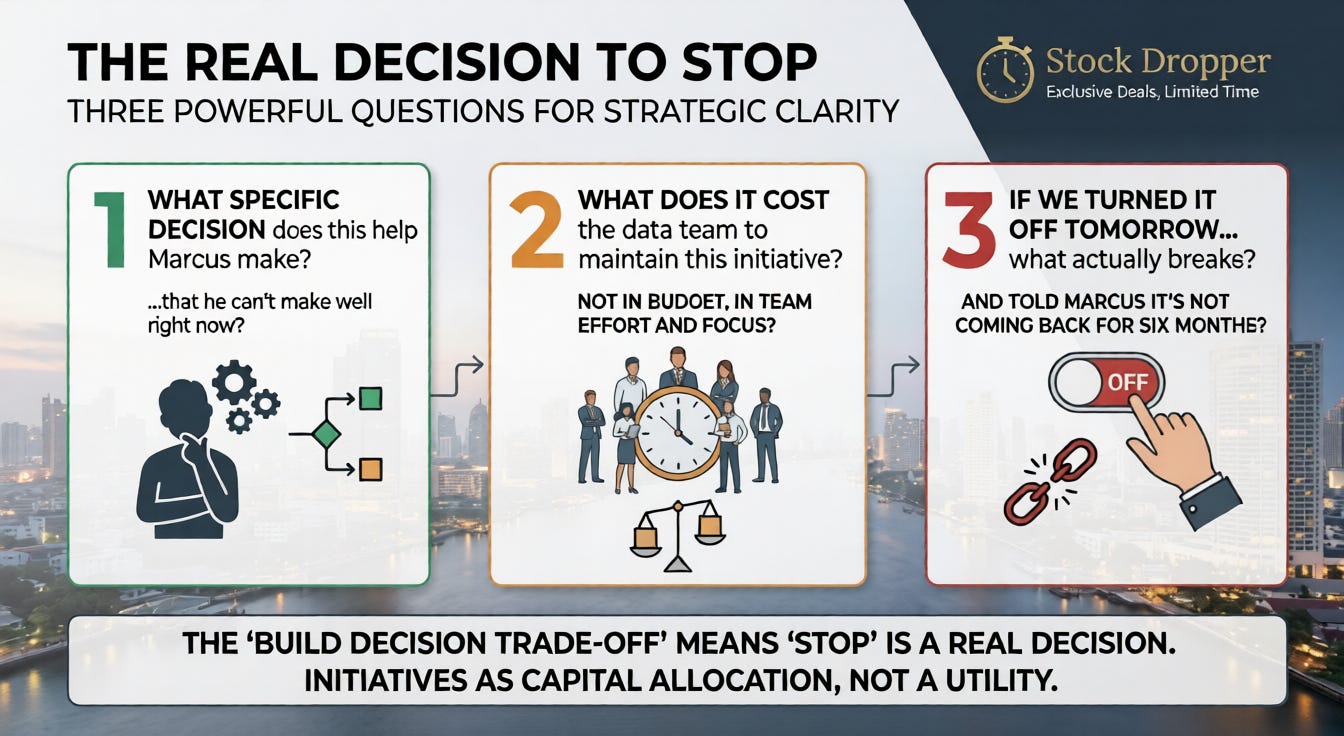
“Okay,” Arjun said. “Three questions.
What specific decision does this help Marcus make that he can’t make well right now?
What does it cost the data team to maintain this thing at 60%? Not in euros, in actual team hours per week?
If we turned it off tomorrow and told Marcus it’s not coming back for six months, what actually breaks?
I started to answer, and then I stopped.
The honest answer to the third question? Probably nothing. Marcus’s team was already working around it. They were still hitting their numbers.
Arjun didn’t make a point of it. He just said: “Now ask yourself why that initiative is consuming the same amount of team attention as the other thirteen. Ask yourself if the decision to keep building it was ever actually made, or if it just kept going because nobody decided to stop.”
The Realization
I’m used to thinking about data as a “build” question. What’s next? What’s the priority? I had never once in four years treated “stop” as a real decision that someone accountable had to make.
Arjun called it the ‘build decision trade-off’.
Every time you add something to the list, you’re deciding what doesn’t get done. You’re just making that decision implicitly, by default, without naming it. And implicit decisions have a way of accumulating until their weight breaks something. Like a €400,000 oversight.
It’s smart, but how do I make this decision? How can I decide which initiative will get the attention? How was I supposed to navigate the stakeholders’ toxic water, which was already thick with mistrust?
I also don’t really trust them
I’m starting to think the problem isn’t our execution speed. The problem is the list itself. We are treating our data team like a utility, like the lights or the Wi-Fi, when we should be treating it like capital allocation. We are spending human hours, our most expensive resource, on “zombie” projects because I didn’t have the stomach to kill them.
But yet - how do I know what to stop? Arjun said it will all come in good time, we will structure and build the muscle to make those decisions, but then it feels like everything we did until now was wrong. I am using data-driven leadership. What’s the difference?
I don’t know what to do with that yet. I have a promise to Tina, thirty days to find a real answer, and the clock is ticking. I have Marcus in my corridor. And I have Arjun asking questions about a list I thought I understood, and apparently don’t.
We’re going back through the other eight initiatives next week. I’m not looking forward to it.
Wish to learn more? My new book, “What Dara Really Costs,” is launching soon. Join the mailing list (I will send only three emails by June 10th; it will be deleted) to learn when it’s on pre-sale